← Home Order now

The maison · the maker

Jérôme

A French baker, a Paris recipe, a New York kitchen.

La Macaronerie began with a favour, a bowl of almond flour, and a batch of macarons that never made it to the person they were meant for. Ten years later, in a kitchen in New York, the recipe became a maison.

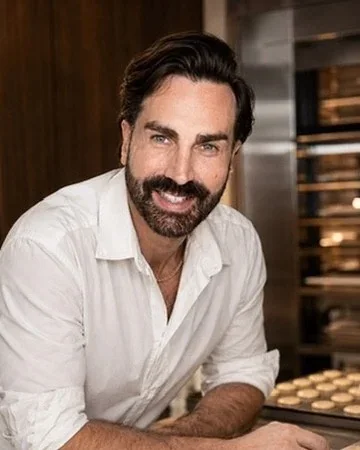
Jérôme, French baker and founder of La Macaronerie, in his New York kitchen

Chapter one · Paris, ten years ago

A debt paid in macarons

A friend, a lawyer, did Jérôme a favour. He could not pay for it in money, so he thanked him in macarons — which he had never made before.

They came out of the oven on the first try: the shells matte on top, feathered at the base, the ganache set overnight in the cold. He put them in a box for his friend. He opened the box that evening, «just to check». He ate them all before midnight. He froze a second batch to save them from himself; they were better frozen, so he ate those too. The third batch finally made it to the lawyer.

That is how a French baker became a macaron baker. Not through pastry school, not through apprenticeship — through a debt he could not pay in cash.

Chapter two · New York, 2024

A homesickness

Jérôme moved to New York two years ago. New York is a city where you can find anything you want — except, he discovered, a macaron that tasted like the ones he used to make for his friends at home.

What is sold here as a «French macaron» is often sweeter, drier, flatter. The shell has no pied. The ganache is a buttercream heavy on sugar. The textures of a real Parisian macaron — the tender crackle of the first bite, the satiny ganache that holds together exactly long enough, the perfume of real fruit or real chocolate — those were missing.

So he started making his own, in his apartment, for himself. For the homesickness.

Chapter three · The rebuild

Three months to find Paris again

The Paris recipe did not work in New York. The almond flour was ground differently. The sugar had a different humidity. The eggs were larger. The city tap water carried a different mineral balance. And the oven in a New York apartment was not the oven in his Paris kitchen.

It took two to three months of trial batches — shells that cracked, pieds that collapsed, ganaches that split — to rebuild the recipe from scratch.

What came out at the end was not a copy of the Paris version. It was a new recipe, tuned to the ingredients and the humidity of New York, that gave the Paris result: a shell that holds, a ganache that lingers, a taste that is unmistakably French and unmistakably from a maker who lives here now.

Chapter four · La Macaronerie

The maison, today

Four flavours, all French in technique, all finished with an American touch somewhere in the recipe. Gilded Midnight, a dark chocolate shell with candied orange and edible 24-carat gold, hiding toasted New York pecans. Caramel Brûlé, an amber shell dusted with Guérande fleur de sel, filled with burnt-sugar caramel and Hudson Valley farmer's butter. Green Ember, a shell coloured only by Sicilian Bronte pistachio paste. Rosy Dusk, a rosy shell coloured by the fruit itself, filled with fresh raspberry purée and a trace of lemon zest.

Every batch is thirty-six macarons, piped by hand, filled one by one, in a professional kitchen in the New York area. No preservatives, no artificial colours, no artificial flavours. Five days of freshness — that is the only way we know how to make them.

Jérôme still makes every batch himself. The first hundred boxes of the Thanksgiving release will be the first that leave the kitchen under the Macaronerie name.
Thanksgiving release. 100 boxes.

Six macarons to a box. Founder's price: $19.90, reserved for the list. Hand-made in New York for the first release.

Reserve my box for $19.90
← Back to the maison